Banks can play a crucial role as treasurers want FX management embedded in core systems
Corporate treasurers expect more of their FX execution to be embedded in their core operating systems, including enterprise resource planning (ERP) and treasury management system (TMS) solutions, as the industry looks to leverage AI and automation.
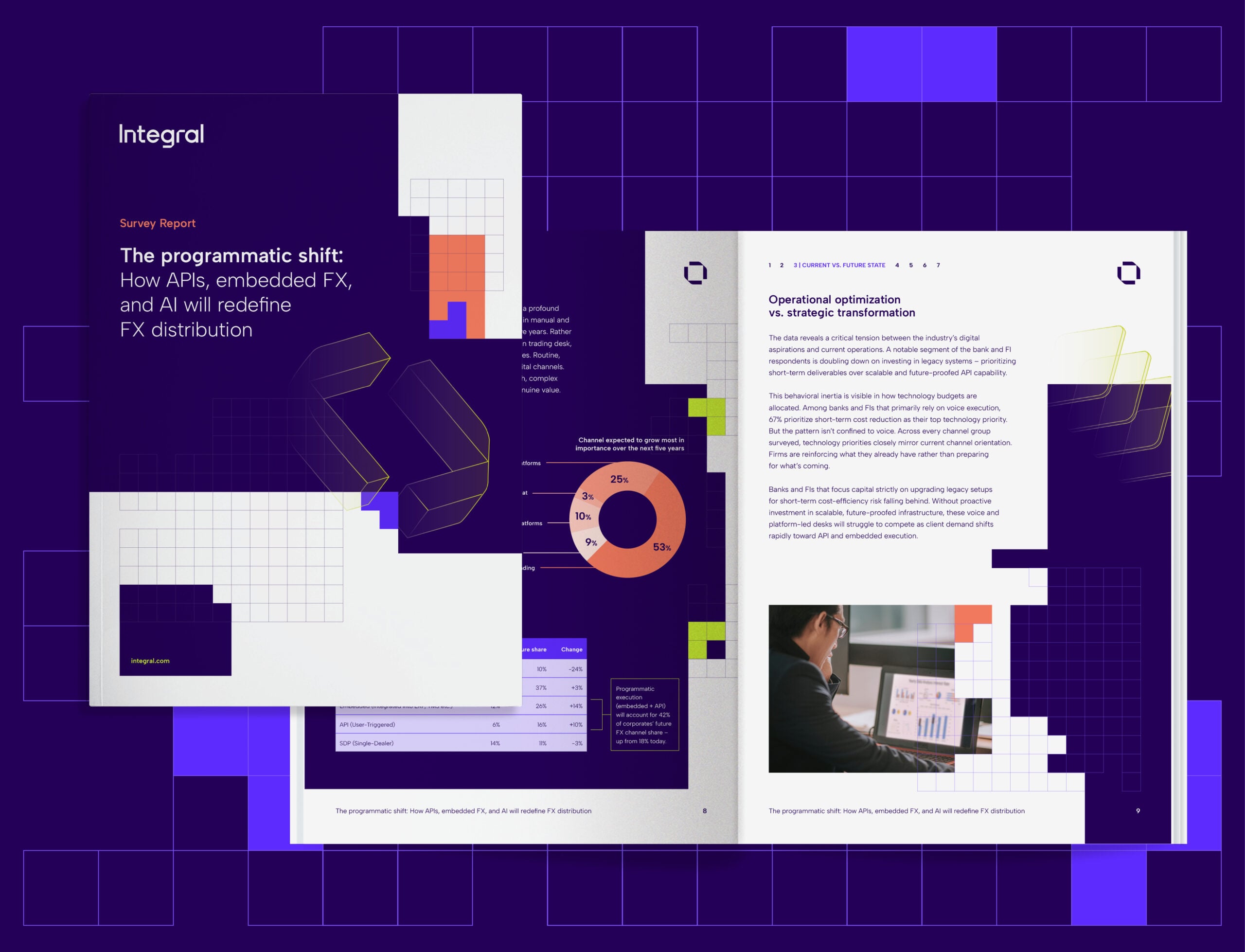
A survey of corporate treasurers and banks conducted by Integral found that most corporate treasurers trade FX through separate channels, with more than two-thirds executing through voice (34%) or multi-dealer platforms (34%).
Over the next five years, treasurers expect to move further away from manual trading workflows to more automated solutions. These methods of programmatic execution are expected to grow from 18% today to 42% by 2031 – from user-triggered API execution (6% to 16% share of trading volume) and fully embedded, automated execution within ERP and TMS solutions (12% to 26%).
More than half of banks surveyed said corporate API trading will be the most important FX execution channel in five years’ time. Over 80% also said prices embedded directly into their clients’ systems – for example, OMS and TMS solutions – will play a significantly greater role in their FX distribution strategies.
While both banks and corporates see the potential of embedded FX management, adoption is not without its challenges. 83% of corporates identified at least one barrier that could slow adoption, with internal system integration cited as the top hurdle for large corporates (56%), and bank API maturity (43%) the biggest challenge for mid-sized corporates and growth companies.
Agentic AI is also set to play a role in automating treasury FX workflows. While only 8% of corporates are currently piloting AI projects, half said they expect AI-driven agents to manage 25% of their FX workflow within the next five years.
The potential impact goes beyond execution efficiency. Nearly two-thirds of corporates said if FX execution were largely automated and embedded, it would enable them to better prioritize risk management strategy – suggesting that embedded, API-driven services and automated trading workflows from banks have implications for how treasury teams allocate their time, not just how they trade.
Harpal Sandhu, CEO of Integral, said: “Corporates are looking for more streamlined and automated solutions to manage their FX risk at a time when market volatility, disrupted trade flows and pressure on balance sheets are making treasury operations more complex. Banks have a crucial role to play and will need to work with their clients to address the operational and technology challenges around embedded FX management. This depends on strong technology foundations, including API first platforms that seamlessly connect banks and corporates and support the adoption of agentic AI.”
Find out more about the survey results by reading the full report here