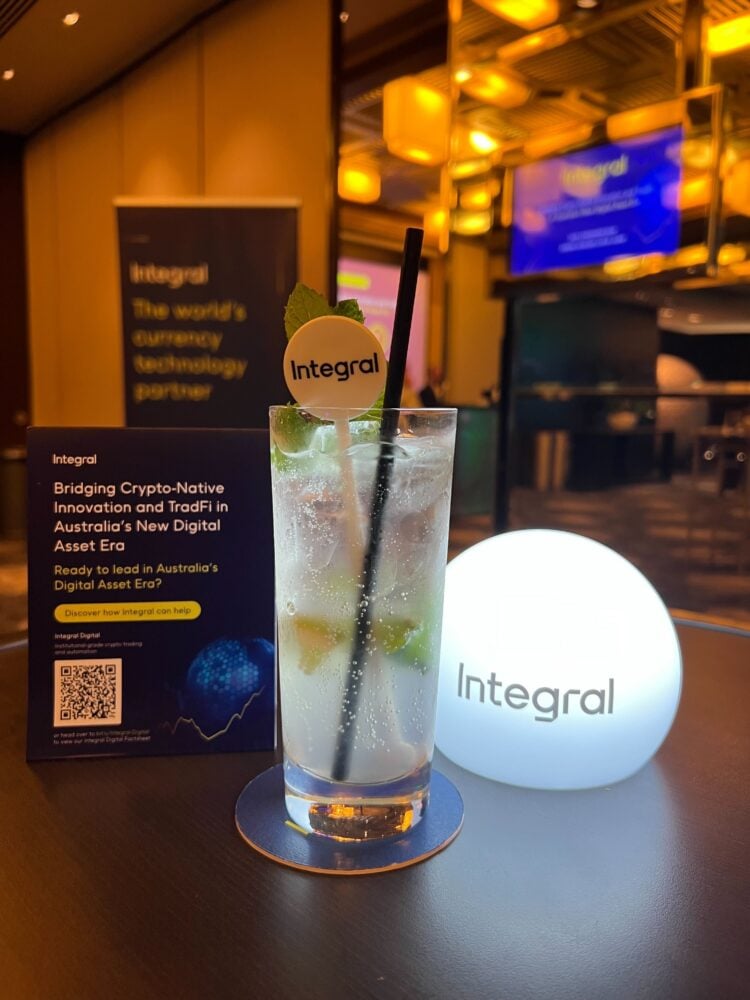

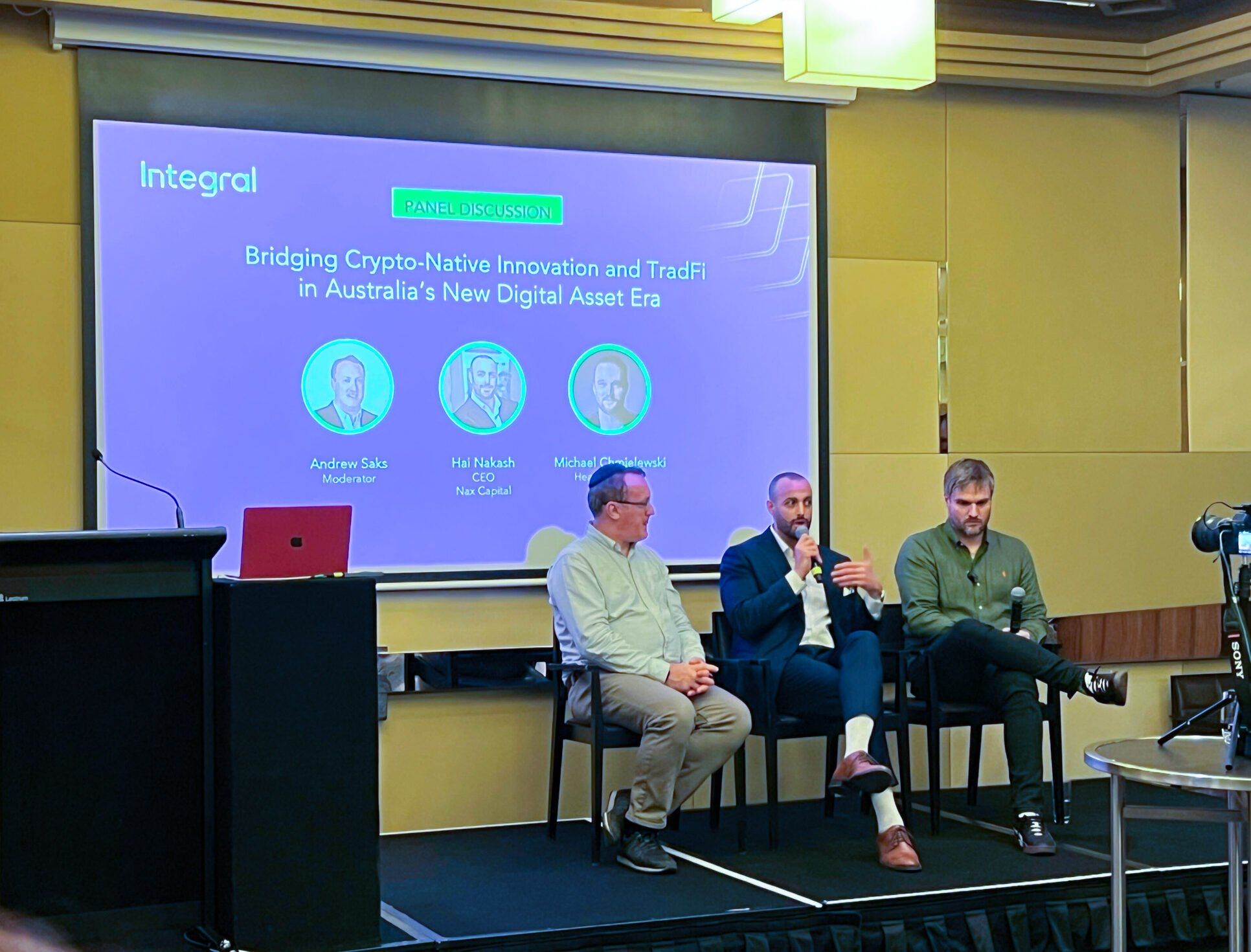
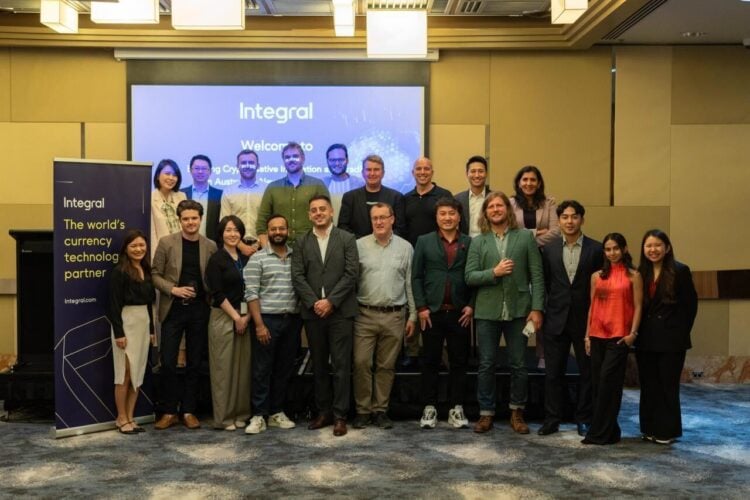
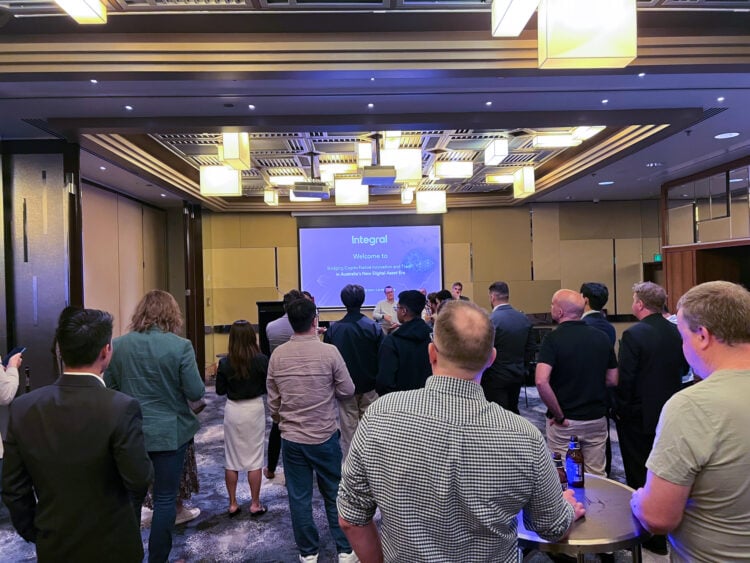
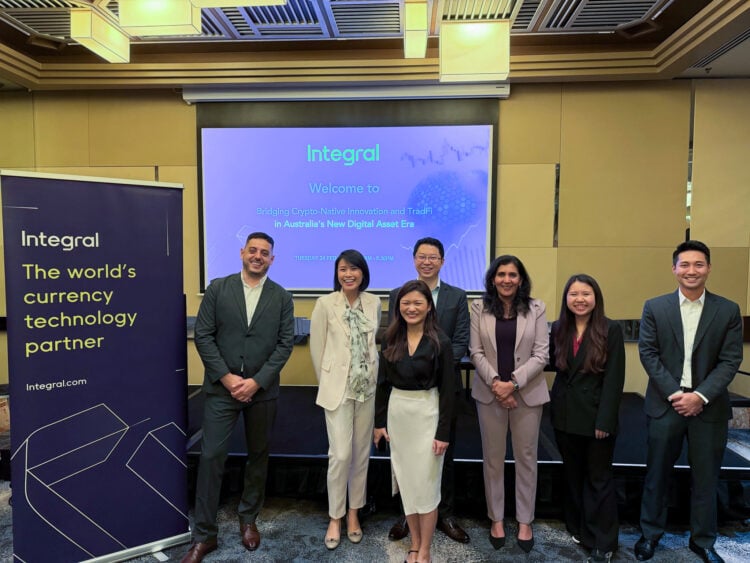
Last week, in one of the Grand Hyatt Melbourne’s glass-fronted conference salons overlooking a city more associated with prime real estate than prime brokerage, a roomful of senior electronic trading executives debated a subject that would have sounded esoteric a few years ago: not whether crypto belongs alongside traditional finance, but how far it can go in replacing the debt-driven structures that have defined retail finance for a century.
Integral’s latest industry event in Australia was framed deliberately as an infrastructure and market-structure discussion rather than another speculative crypto discussion. The focus was firmly B2B: licensing, custody, tokenization, and the practical realities of building a business that sits between crypto-native innovation and the new Australian regulatory regime.
The panel brought together Day1x’s Michael Chmielewski and Nax Capital CEO Hai Nakash, and moderator Andrew Saks.
What followed was less a panel and more an extended working session on what happens when crypto firms stop behaving like trading companies and start behaving like full-stack financial institutions.
From CFD vs crypto to “everything financial in one place”
For the better part of a decade, most broker conferences have framed the debate around the same binary: CFDs versus crypto, retail trading versus speculative tokens, the “old” versus the “new”. That conversation felt noticeably outdated in Melbourne.
Right from the outset, the tone was different. Rather than treating crypto as a rival product to FX, both Michael and Hai spoke about a complete financial ecosystem that has moved well beyond the early-exchange days and is now acquiring FX and securities brokerages to obtain distribution, licenses and existing client bases.
The examples were not theoretical. Recent deals such as IG Group’s acquisition of Australian crypto firm Independent Reserve, and Crypto.com’s purchase of Australian FX broker Fintek, were cited as proof that the M&A traffic now flows both ways.
Crypto firms are no longer the upstarts begging for a seat at the CFD table; they are buyers of regulated entities and, in some cases, the more diversified businesses.
The front end: crypto has to feel like everyday life
If there was a single recurring theme, it was this: the UI is the on-ramp for the mass market.
Hai Nakash argued that crypto-native platforms will only break out of the enthusiast bubble when the initial user experience stops signalling “engineer’s playground” and starts feeling like any other mainstream app. That does not mean dumbing down the underlying infrastructure; it means incorporating the complexity behind a familiar, intuitive front end.
Under that skin, he envisages a single environment where users can:
- Hold and spend via debit cards integrated into Apple Wallet.
- Invest in tokenized real estate and other real-world assets in fractional form.
- Move value globally without friction or capital controls.
- Onboard and comply with regulations without noticing the machinery working behind the scenes.
In other words, a retail experience that looks like modern mobile banking or a neobank app, backed by an engine that is anything but traditional.
Beyond “yet another trading platform”
That led naturally to the second major shift in the discussion: crypto infrastructure is not just another trading platform. Michael highlighted that many of the projects that leaders in the development of the digital asset ecosystem have worked on are not simply offering spot trading or perpetuals; they are building multi-function environments that combine:
- Payments
- Tokenized asset investment
- Borrowing against crypto collateral
- Open-source blockchain projects
- Everyday retail spending
This is where the oft-abused comparison with electric vehicles actually felt appropriate. Andrew suggested that for over 120 years, cars were essentially the same product: four wheels and an internal combustion engine. Electric cars had existed for decades, but the early prototypes were impractical, unfamiliar and niche. It took an outsider to build an electric car that looked and behaved like a normal car for the market to accept that the underlying drivetrain had changed.
The panel’s view was that crypto is approaching a similar inflection point. When a crypto-native stack behaves like a bank, a neobank, a property investment platform, a contactless payment solution and a cross-border settlement solution all at once the infrastructure changes, but the user’s mental model does not. At that point, legacy firms are forced to join in rather than treat crypto as an optional add-on.
Tokenization: from hype to product/market fit
The buzzword of the year, tokenization, did not escape scrutiny. The panel spent time separating real product/market fit from marketing gloss.
Areas where tokenization appears to be finding traction today include:
- Collateral management
- Private markets and structured products
- Real-world assets such as real estate, invoices and commodities
These are, crucially, B2B revenue lines rather than retail gimmicks: segments where institutions already understand the underlying asset and care about settlement efficiency, fractionalization, and global reach.
Yet the panel was clear that tokenization is only meaningful if the supporting pillars are in place:
- Regulated, robust custody
- Credible valuation methodologies
- Proper longevity and liquidity that goes beyond a thinly traded token on a minor venue
- Compliance that can survive a regulator’s audit, not just a whitepaper
That naturally brought us back to infrastructure. To operate at this level, firms require a stable, multi-tenant back end with a highly developed API structure so that spot crypto can be managed as a distinct domain, integrated but not muddled with other asset classes. The discussion touched on how institutional-grade multi-asset cores – the type of SaaS infrastructure used in FX and securities – are now being adapted to support digital assets as just another product set within the same engine.
Debt, mortgages, and a new retail balance sheet
The conversation became more philosophical when the subject turned to retail balance sheets. Michael took the view that if banks want to retain a connection to younger retail clients, they may find themselves acquiring or partnering with crypto firms, not the other way round.
His reasoning was simple: the traditional model of unsecured loans, credit cards and 25–30 year mortgages is increasingly out of step with an economy where:
- Retail investors can borrow against their crypto collateral without enduring the friction and criteria of bank lending.
- Fractions of assets – from property to art – can be bought without committing to a single, leveraged purchase.
Andrew explored this further: if tokenized real estate becomes mainstream, does the 30-year mortgage become a marginal product? Rather than saving for a “deposit” to buy an entire property and taking out life-defining debt, a generation could allocate gradually into fractional property positions, building exposure without leverage.
The panel stopped short of declaring mortgages obsolete, but the direction of travel was clear: crypto and tokenization enable a retail investment world less dependent on traditional debt products. That is politically and socially loaded territory, but it is hard to ignore given the relative pace of innovation.
Stablecoins: parallel banking versus speculative assets
The Q&A was notably engaged. Many attendees were senior figures from Australia’s electronic trading sector, bringing questions that were less “what is blockchain?” and more “how do we price and risk-manage this?”
One particularly lively exchange was prompted by a senior representative from Pepperstone, steering the panel into a three-way debate about stablecoins.
The discussion drew a sharp distinction between:
- Stablecoins as the foundation of a conservative, parallel banking system – a quasi-deposit layer that can support payments, savings, and settlement.
- Non‑tethered digital assets such as Bitcoin and Ethereum, which remain fundamentally investment vehicles, with volatility profiles closer to speculative tech equities than deposits.
The panel broadly agreed that conflating the two is unhelpful. If stablecoins become normalized as a transaction and savings medium, they effectively create a democratic alternative to the legacy bank balance sheet. Meanwhile, non-pegged assets continue to evolve as high‑beta exposure for those willing to absorb the risk.
For brokers and other B2B firms, that distinction matters. One set of products demands market‑making, margining and volatility management; the other demands a mindset closer to payments and treasury operations.
Australia’s regulatory reset – opportunity or obstacle?
Although the session’s title referenced Australia’s new digital asset regime, the conversation was notably pragmatic rather than legalistic. Attendees wanted to know:
- How the upcoming licensing and custody frameworks will affect exchanges, brokers and liquidity providers.
- Which tokenization use-cases are most likely to scale first in the Australian institutional market.
- How clients – from retail brokers to family offices – are currently asking for tokenized products.
Here the consensus was that Melbourne and Sydney find themselves in a window of opportunity. A clearer digital asset licensing framework, if implemented with a degree of flexibility, could make Australia a preferred jurisdiction for firms wanting a credible regulatory home without the fragmentation seen elsewhere.
At the same time, the panel acknowledged a familiar risk: if the rules are written in a way that treats digital assets as an awkward bolt-on to legacy categories, innovation will simply relocate to more permissive venues. The practical suggestion from the floor was that infrastructure providers, brokers and crypto-native firms need to engage regulators early, rather than waiting for a finished rulebook.
A vending machine with no receipt
One throwaway analogy captured a lingering concern about user experience and accountability. We discussed the rise of vending machines with contactless-only payments and no receipts – frictionless, yes, but opaque when a dispute arises.
The warning for crypto platforms was implicit: removing friction must not mean removing transparency. If a crypto-powered, all-in-one financial app is to replace the traditional bank relationship for many users, it will need to offer not only instant, global settlement but also the essential artefacts of finance: statements, records, audit trails, recourse.
What Melbourne’s room really said
If there was a conclusion to draw from Integral’s event at the Grand Hyatt, it was this: the Australian conversation about crypto has matured significantly.
No one in the room was asking whether Bitcoin would “go to the moon.” Instead, brokers, technology providers and crypto-native founders were testing where digital assets slot into an already sophisticated electronic trading and wealth management industry.
The next 12–18 months, as one of the panellists noted, will not just be “interesting” in the abstract. They will likely determine whether crypto in Australia becomes:
- A parallel, people-powered financial stack that forces traditional institutions to adapt, or
- A niche product set that remains confined to the speculative end of broker product menus.
On evidence from our event in Melbourne, the industry is quietly, and quite seriously, preparing for the former.