

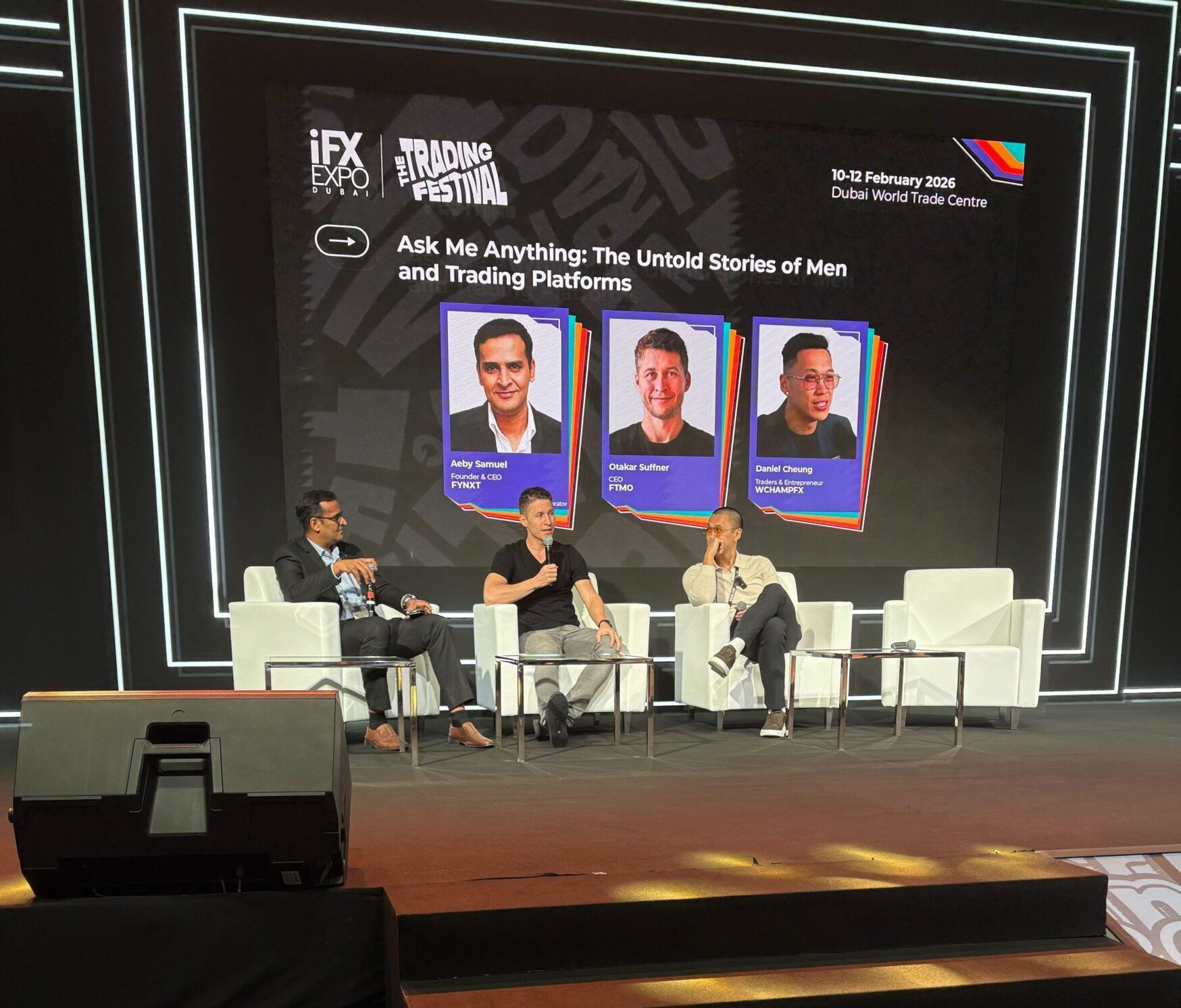
The headline panel on day one from iFX EXPO Dubai 2026 carried an uncharacteristically candid title for an institutional conference: ‘Ask Me Anything – Untold Stories of Men & Trading Platforms’. It delivered exactly that.
On stage were three men whose careers sit at the junction between retail brokerage, proprietary trading, and the new breed of infrastructure providers: Aeby Samuel of FYNXT, Otakar Šuffner, co‑founder and CEO of FTMO, and prop‑trading evangelist Daniel Cheung of WCHAMPFX.
What emerged over the course of the session was a raw examination of who really owns the future of trading, whether it is the brokers, the prop firms, or the technology.
The Prop Promise
Daniel Cheung set the tone early with a statement that would have made many retail brokers shift in their chairs. “Prop trading is for normal people,” he said, stressing each word. His point was not philosophical; it was economic. “Not everyone has hundreds of thousands of dollars. You start with 500 dollars. From a retail perspective, you can appear to make your dreams come true.”
Cheung, who described his own background working on road bridges and in supermarkets, contrasted the more linear path of traditional employment with the appeal of a funded‑account model. “It is so much easier to make a stable living out of prop firm trading than out of retail trading,” he argued.
The arithmetic that underpins the dream is familiar to anyone who has ever opened a MetaTrader demo: turn 500 dollars into 40,000 dollars a year. “It appears impossible but is a challenge,” he said – and then came the line that will ring in the ears of many IBs and dealing desks: “Many traders feel like brokers want to try to resist paying out. The question most retail traders think is: what’s the point if I won’t get paid?”
That sense of disillusionment with traditional retail brokerage was the backdrop to Otakar Suffner’s story of how FTMO came into being, a narrative that has already become part of industry folklore, but which he retold with a level of detail that brought back just how unlikely its trajectory was. He and his co‑founders started with savings of just 3,000 dollars. Even at that level, he explained, they couldn’t make a living, so they did what any ambitious, quantitatively‑minded young traders might do: they looked for a way into the prop trading desks of established firms in London and the United States. “We found retail trading firms, but many didn’t reply because we didn’t go to Ivy League schools,” he said.
Instead, they opened a small office near a university, went there every day, and “refined our knowledge” while they figured out how to build something of their own. The turning point came when they discovered a US firm which had futures traders using a model that would later become familiar: take a test, and if you pass, you receive capital to trade on behalf of the firm. “We decided in 2013 to do it ourselves,” Šuffner said. It was not, he added, the overnight success story that many see today. “For the first five years, we had no salary out of it.”
Flow Reversal
Today, the flow has reversed: prop firms that “came from nowhere” in the eyes of many brokers now have the balance sheets, client bases and technological sophistication to buy mainstream retail brokers outright. Šuffner was characteristically understated about the deal itself.
“We recently acquired OANDA because the idea is to become a diversified trading house and offer more services to clients. OANDA is a global firm; it makes sense,” he said, but the implications are hard to ignore.
When a prop firm with its roots in trader evaluations takes over a legacy broker with a 1990s dot‑com pedigree, it confirms that the gravity in this industry has shifted toward those who control the technology and the flows.
Differentiate with Robust Back-End Infrastructure
It was at this point that the discussion turned, inevitably, to infrastructure. If prop houses like FTMO are now buying traditional brokers, what can a broker do to avoid being on the menu?
The answer, delivered from the stage and echoed inside conversations in the corridors afterward, is disarmingly simple: build, or at least control, a robust back end. Ensure that you can manage your own business direction; that you can expand across new asset classes; that you can offer different trading experiences and products to different client segments without waiting for a third‑party platform vendor to bless the roadmap. In other words, stop being just a logo on someone else’s front end.
Payout Psychology
Cheung, speaking from the trader’s side rather than the corporate buyer’s, was keen to stress that prop firms are still at an early stage as an industry segment, but in his view they are destined to become part of everyday financial life. He described a funded trader’s first payout as a kind of rite of passage. “If you get your first payout when you have been funded, you get your money back and the payout. Then there is very low risk,” he said.
Once that money hits a trader’s bank account, the psychological contract changes; prop is no longer a marketing slogan, it’s a proven channel. The model, he noted, is evolving rapidly: “There are now futures prop firms, crypto prop firms, and there is still so much more to develop. Many don’t know about it yet, and people think trading is stocks, FX using personal capital. Now institutional prop firms exist where they give you equity to invest.” In other words, the model is moving up the value chain, from small‑ticket retail funded accounts to institutional‑grade allocations.
Where Daniel Cheung saw opportunity and Otakar Šuffner provided the case study, Aeby Samuel took on the role of the industry’s questioner, probing how far the model could go and what it meant for incumbents.
Diversification using Core Trading Infrastructure
Picking up on Šuffner’s remark that some parts of the traditional brokerage sector had seen “little innovation for many years,” Samuel asked him to look ahead a few years. What, he wanted to know, does someone in Šuffner’s position see coming next?
The answer, predictably but no less importantly, revolved around services and diversification: more ways to serve clients, more asset classes, more tailored offerings that go beyond the old FX‑plus‑CFDs catalogue. Between the lines, however, lay the implicit warning: firms that do not diversify – operationally, technologically and in product terms – will find themselves either irrelevant or absorbed.
The examples are already there. A handful of prop firms have quietly acquired brokers over the past two years, especially in jurisdictions where a licence plus a book of clients can be picked up more easily than building from scratch.
For the acquired brokers, the pattern is familiar: generic, third‑party front ends; little to no ownership of core IP; volumes strong enough to make money month to month but with no clear path to an IPO or strategic sale at a meaningful valuation. Once a prop firm with a sticky, tech‑centric client base walks into that picture with cash in hand, the endgame is predictable.
In that light, perhaps the most important part of the panel was not the war stories but the architecture talk. All three speakers, in their own way, came back to the same theme: if you want to survive the next phase, you need a core trading infrastructure that is both robust and genuinely multi‑dimensional.
That begins with the back end: a risk engine that is sophisticated enough to handle multiple front ends and business lines, from classic margin FX and CFDs to funded‑account structures, futures, crypto and whatever tokenised instruments emerge next. It means being able to cater to very different trader behaviours – high‑frequency traders, long‑only investors, evaluation‑phase prop candidates – under one risk framework, without tying the entire firm into a single off‑the‑shelf platform.
The Role of AI
It also means preparing for a new category of risk: traders using the same AI tools that brokers and vendors like to talk about in their marketing slides, but deploying them to game the system. Both Cheung and Šuffner acknowledged, with a mixture of amusement and concern, that some traders are already using artificial intelligence to try to cheat evaluation models and exploit weaknesses in platforms’ internal logic. In that world, an “adequate” risk engine is no longer enough. You need infrastructure that can detect patterns across accounts and strategies, that can differentiate between genuine skill and coordinated abuse, and that can adjust conditions or shut down strategies in real time without taking the entire platform offline.
Panel Takeaway
The panel’s title promised “untold stories,” but what it actually exposed was something more structural: an industry in which the lines between prop firm and brokerage are blurring, and in which control of technology is determining who climbs the ladder and who becomes an acquisition statistic.
Prop firms, once the upstarts at the edge of the retail business, are now buying global brokers and positioning themselves as diversified trading houses. Traders who once dreamed of compounding a small personal account now look to funded programmes as their route into the markets. And traditional brokers, many of them still running “one‑size‑fits‑all” platforms, are being forced to confront a much less comfortable question: in a market where your counterparties own their infrastructure, their IP and increasingly your competition, are you still a business – or just a distribution channel waiting for someone else’s logo?