

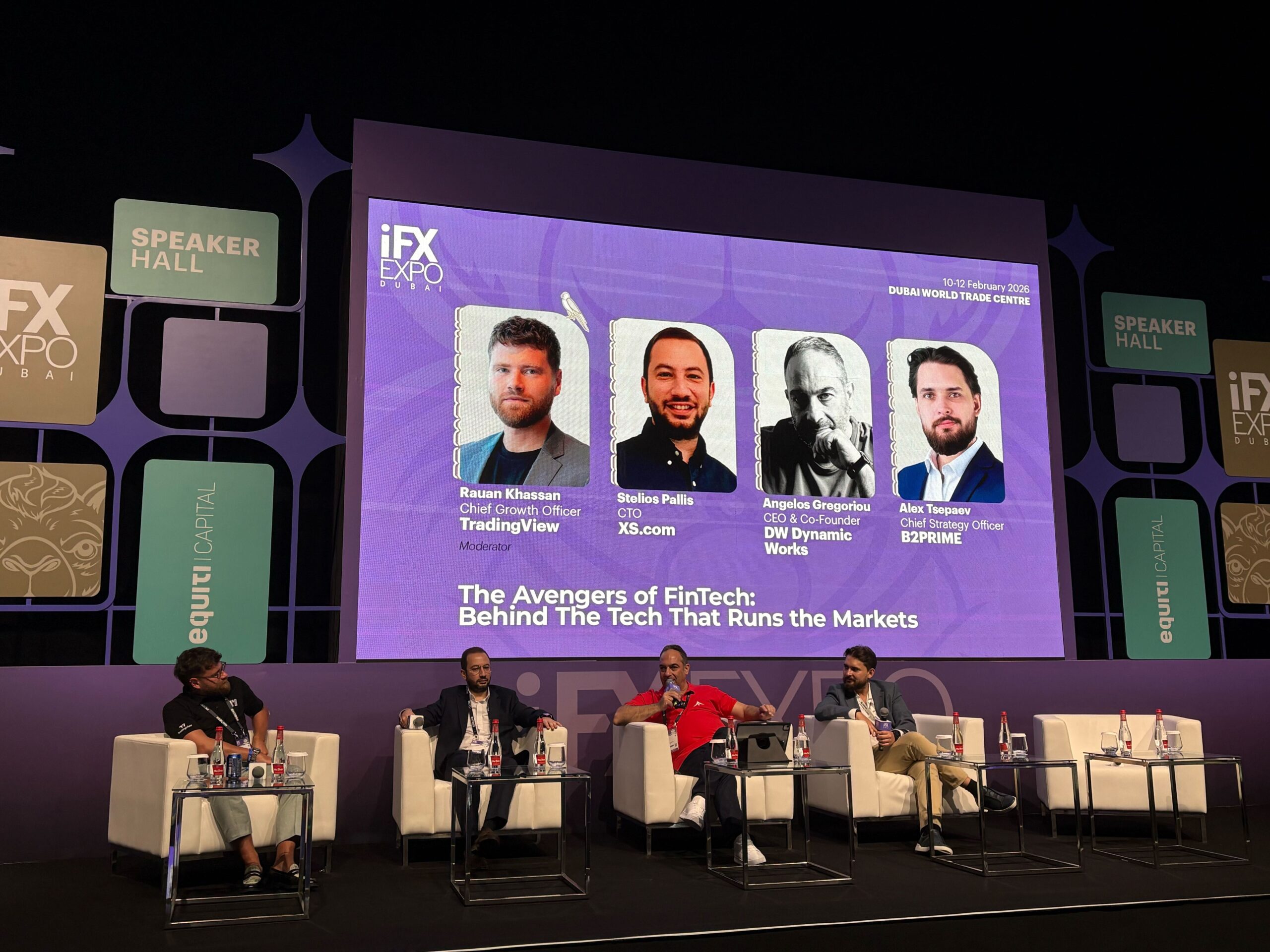
The “Avengers of Fintech: Behind the Tech That Runs the Markets” panel at iFX EXPO Dubai 2026 moved beyond surface-level innovation talk by confronting the rapidly widening gap between legacy systems and the infrastructure modern markets demand.
Moderated by TradingView’s Ruan Khassan, the lineup including Stelios Pallis of XS.com, Angelos Gergoriou of DW Dynamic Works, and Alex Tsepaev of B2PRIME, didn’t hold back on the brutal realities of scaling a trading business in 2026.
The New Complexity of Modern Brokerage Infrastructure
With prop firms snapping up brokers, metals volumes spiking, and the high demand for diversified asset classes including futures, options, crypto and fixed income, the question hanging over the room was simple: how do you build technology that doesn’t just survive volatility, but owns it?
Reliability Under Volatility: The Back End as the Backbone
Rauan Khassan wasted no time cutting to the chase, asking Stelios Pallis how firms should approach back-end diversification. Stelios Pallis, who joined XS.com to overhaul its infrastructure, was blunt: reliability trumps everything. “Building a reliable system is very important,” he said.
“Reliability means the system must behave in a predictable manner, especially when there is volatility” said Stelios Pallis. He dismissed the idea of everything being built in-house as unrealistic – “we are investigating other third-party tools but we need scalability” – but made clear that the back end isn’t negotiable. Whether running legacy accounts alongside new systems or partnering with providers, the goal is the same: a foundation that scales without cracking under pressure.
One Core Infrastructure vs Fragmented Stacks
Alex Tsepaev of B2PRIME took direct aim at the multi-back-end over-complexity that plagues so many firms. “In order to support multiple back ends you need different front ends – it is very painful,” he said. His preference is uncompromising: one core infrastructure. “It is much easier to have one back end… don’t have to deal with many platforms, many back ends, and can implement things across the board without fragmentation.” Tsepaev emphasised the front end’s critical role too, but with a caveat: “The front end is an important component, but it’s no good having a shiny front end if you do not have a comprehensive and good quality back end which can give proper and full control to a broker over all aspects of the trading experience. Then the most important area of broker operations is missing.”
The Client Portal: Where Infrastructure Meets Experience
Angelos Gergoriou shifted the focus to user experience, but from a less glamorous angle: the client portal as the “first impression.” For DW Dynamic Works, that means embedding compliance from the outset. “We need to ensure there is a compliance onboarding process taking place,” he explained. “There should be a multi-jurisdictional function in place, automate KYC, proper presentation to the client portal and smooth transition to the trading environment.” It’s not just retail clients who need that polish – IBs and affiliates rely on the same systems for rebates and performance tracking. Gergoriou’s vision extends further: AI-driven lead scoring, voice call analysis, and automated retention tools that prioritise high-value clients and keep them engaged without manual intervention.
AI as Operational Infrastructure, Not Buzzword
When Rauan Khassan noted that they’d reached 11 minutes without mentioning AI – a rarity at any fintech event – Alex Tsepaev candidly explained what had taken place at B2PRIME. “We fired many developers and replaced them with AI,” he said.
“From front-end design to daily transaction monitoring and toxic order detection, AI has become the de facto operational work at B2PRIME. The resistance, he admitted, comes not from the tech but from the people: “There are developers who know how to do it but are resistant.”
Rauan Khassan revealed that TradingView has taken a more conservative approach, keeping most automation in-house but now preparing to release tools that aggregate SEC filings and RSS feeds into simple text summaries where no Dow Jones or Refinitiv subscription are required.
Angelos Gergoriou doubled down on AI’s marketing potential: “Marketing automation is a very important aspect, driving marketing and retention campaigns, and automation of assigning leads to different teams.” His system uses locally hosted LLMs to analyse lead characteristics – demographics, acquisition channel, IB campaign – against historical data, then routes them to the right handler with predictive success scores. “This is a big value for brokers,” he said, painting a picture of sales teams armed with insights that turn guesswork into precision.
If You Had to Choose: Where Does Investment Go?
The panel’s closing question forced priorities: with the year half gone, where do you focus next – trading engine back end, middleware/user acquisition, or user-friendly front end? Stelios Pallis didn’t hesitate: “For me the most important is the back end because that’s the backbone of the system. If this is not scalable or able to sustain growth then it is very difficult to be competitive at all.” Angelos Gergoriou echoed the need for stability but with a client-facing approach: “Constantly focusing on performance and the need to give more tools to brokers for them to be more self-sustainable when using our systems, to be more in control of their own business.”
Panel Takeaway: Back End Infrastructure as Strategy
What lingered after the session was a shared conviction: in an industry where prop firms buy brokers, gold swamps order books, and every trader expects crypto alongside FX, the back end isn’t background noise, it’s the entire objective. Front ends dazzle, AI automates, UX retains, but without a scalable, predictable core that can orchestrate multiple assets, jurisdictions and client types under one roof, you’re not building a trading firm. You’re just renting one. iFX EXPO Dubai made that clearer than ever.