
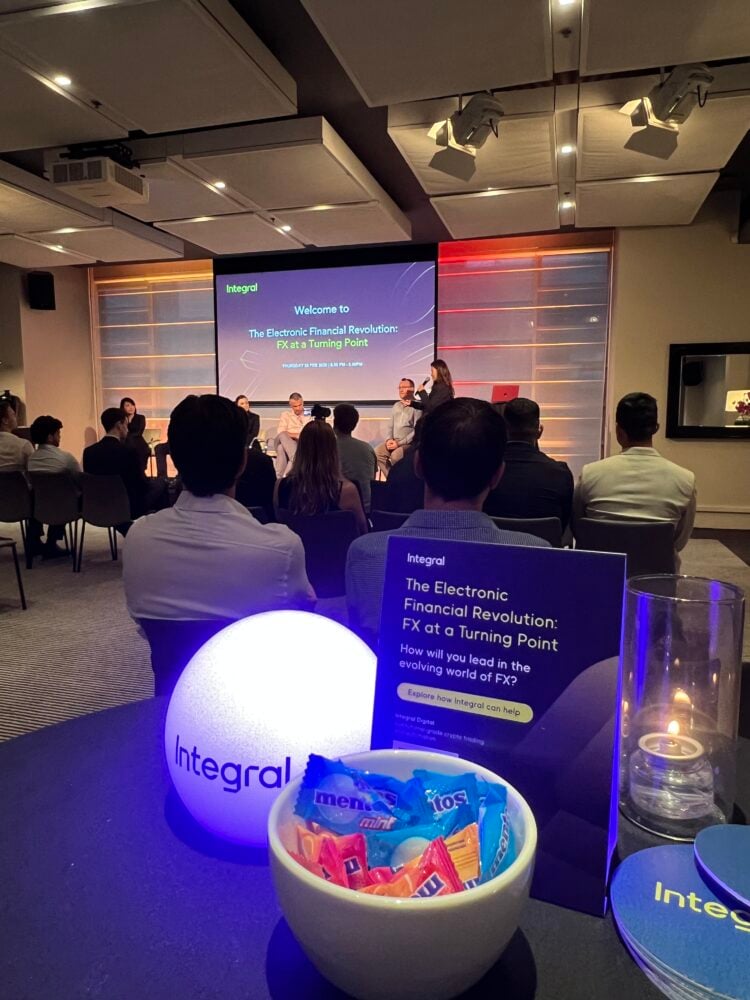
At Integral’s most recent broker event in Sydney, instead of asking whether crypto deserves a slot on the product menu, the room grappled with a sharper question: what happens to FX brokers when crypto, AI‑driven front ends and community‑led platforms have already stopped being side bets and are rewriting the methodology of multi‑asset trading?
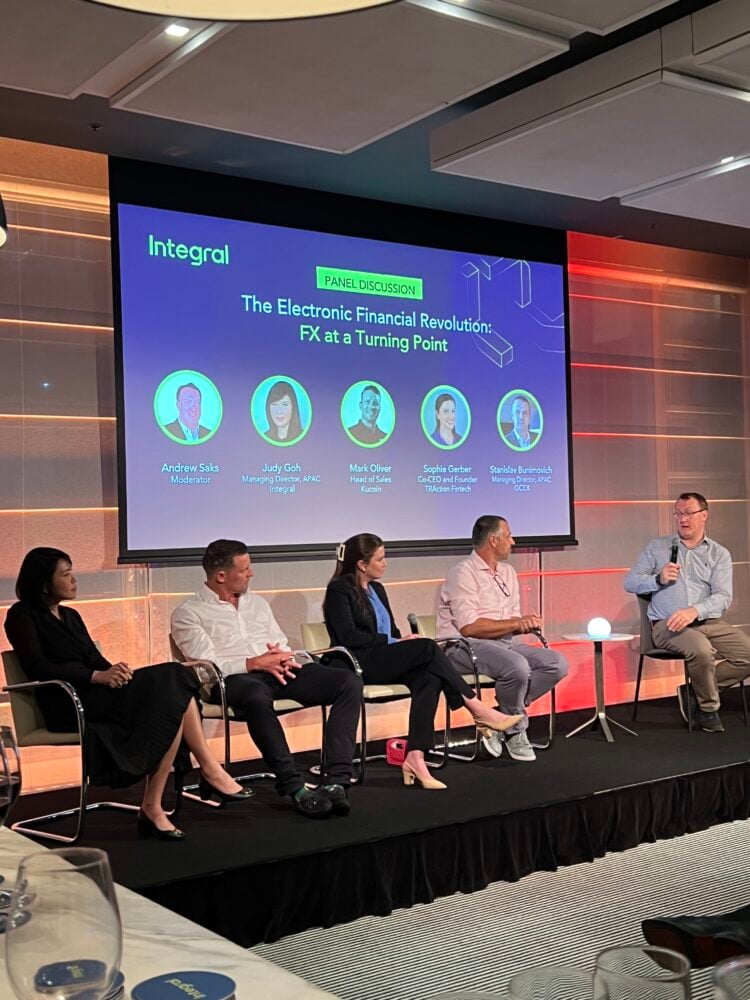
Moderated by Andrew Saks, the panel at Integral’s second Sydney event brought together TRAction Fintech’s Sophie Gerber, GCEX’s Stanislav Bunimovich, KuCoin’s Mark Oliver and Integral’s Judy Goh.
The starting point was blunt: FX is still the world’s largest, most liquid market, but margin compression and increasingly sophisticated clients are forcing brokers to look beyond spread capture. The “new internet” which comprises new tech such as Web3, layer‑two networks, stablecoins, AI agents and user‑built interfaces is reshaping expectations around access, settlement speed and user experience. For the Sydney audience, the question was not whether to modernize, but how fast.
From One Platform to 3,000 Interfaces
One of the most pointed exchanges came when Andrew turned to Sophie with a scenario that had not been a discussion point until recently. Today’s traders, affiliates and introducing brokers live in a world of intuitive apps in every other part of their lives. Increasingly, the most sophisticated among them are not just customising layouts; they are building their own user interfaces on top of brokers’ APIs.
Andrew asked: if a broker has 3,000 active clients and each can effectively develop their own front end, are we heading for a world where a single brokerage could be connected to 3,000 different user interfaces – all talking to the same core via API? And if so, how on earth do regulators manage that?
Sophie’s answer cut through the anxiety. “You’re being very optimistic,” she suggested. Her perspective was that regulators are unlikely to concern themselves with the aesthetic or even structural details of client‑side software. Their focus will remain on execution quality, fair pricing, best‑execution obligations and the integrity of the underlying trading and risk systems. In other words, whether a trade is routed from a classic white‑label platform or from a user‑built, AI‑enhanced front end is secondary; what matters is what happens when that trade hits the broker’s engine.
That perspective framed a broader reality: the locus of regulation is still the dealer and the venue, not the interface. Brokers may soon find themselves operating as “trading clouds” serving thousands of highly individualised UIs, but from the regulator’s point of view, the key questions remain: Is the pricing fair? Is the risk managed? Is the client being treated properly?
The Community Is the Product
If the front‑end debate illustrated how FX is changing at the edge, Mark’s contribution showed what happens when you change the scale. When Andrew approached him about KuCoin’s reported 60 million clients, a universe compared to the few thousand active accounts at many medium sized FX brokers, the natural question was how this came about, and what it means for traditional players.
Here, the conversation moved from user experience to community. Both Mark and Stanislav stressed that crypto and prop‑trading firms have mastered the art of building large, engaged communities long before worrying about conventional marketing funnels. Rather than treating clients as distant account numbers or targets for harvesting the reward from client losses, they cultivate ecosystems which include education, social interaction, copy‑trading, tournaments, token incentives and then recruit traders and partners from those communities.
Done well, this model avoids one of the classic FX pitfalls: the adversarial relationship between broker and client. When the community is the starting point, and the trading relationship grows out of that, the risk of a rift diminishes. The broker does not sit on one side of the table and the trader on the other; they are, at least in theory, participants in the same ecosystem.
Scale changes the M&A calculus too. With KuCoin becoming so large so quickly, Mark noted that it has effectively moved itself out of realistic M&A target range for most traditional firms, even sizable listed brokers. Instead, it stands as an example of how crypto‑native platforms can lead consolidation efforts, rather than waiting to be bought.
That theme echoed in the discussion of IG Group’s acquisition of Australian crypto exchange Independent Reserve for 178 million Australian dollars. No one on the panel feigned surprise at the price tag. The logic was straightforward: a large base of engaged crypto clients is now a strategic asset in its own right, and established FX and CFD houses are willing to pay accordingly. In that light, the line between “broker” and “exchange” is blurring into a broader category: whoever owns the community and the infrastructure owns the future deal flow.
Perps, CFDs and the New Approach to Risk
The conversation naturally turned to what, exactly, these communities are trading. Perpetual futures have become emblematic of the crypto derivatives boom. Drawing on examples like TMGM’s exploration of crypto perps for retail traders, the panel examined whether such products threaten to cannibalise traditional CFD business or simply expand the universe of leveraged risk.
Stanislav explained that perps speak the language of the crypto‑native trader: 24/7 markets, deep exchange‑style liquidity, and a structure finely tuned to on‑chain collateral and funding. CFDs, by contrast, remain deeply embedded in regulated broker frameworks, particularly in jurisdictions that emphasise investor protections and leverage caps.
The panel’s view was that the real shift would not be from CFDs to perps in a zero‑sum sense, but towards a multi‑asset core where both structures live side by side.
For brokers, the differentiator will be whether their back ends can handle multiple margining regimes, venues and product logics without breaking under their own complexity. Those that can will be able to plug into crypto rails, prop‑style leverage models and traditional CFD books simultaneously; those that cannot will struggle to keep pace with client expectations.
Infrastructure First: Build From the Inside Out
Judy took the conversation toward looking at a simple but important matter: the core trading infrastructure. In a world where a single broker might be serving everything from spot FX and indices to tokenized treasuries and on‑chain perps, and doing so through hundreds or thousands of user‑designed interfaces, the only defensible strategy is to build from the back end out.
Her view was that a solid, multi‑asset, API‑rich core is now non‑negotiable. If the core is robust, asset‑class‑agnostic and designed for multi‑tenant connectivity, the broker can afford to be generous at the edge: let communities bring their own interfaces, let partners plug in their favourite tools, let prop firms and hedge funds build entirely bespoke front ends. The job of the broker becomes to provide execution, risk management, market data and regulatory discipline – and to let the ecosystem innovate on top.
This is where the earlier debate about “3,000 user interfaces for 3,000 clients” loops back into strategy. In Judy’s model, that fragmentation is not a problem to be feared but a sign of a healthy platform: a broker that resists locking clients into a single screen and instead competes on depth, reliability and openness. The prize is durability. Firms that cling to closed, front‑end‑centric stacks risk becoming obsolete as traders gravitate to environments where they can bring their own tools and connect via clean APIs. Brokers who treat their core infrastructure as a competitive asset, rather than a cost centre, will be the ones setting the terms of the next consolidation wave.