


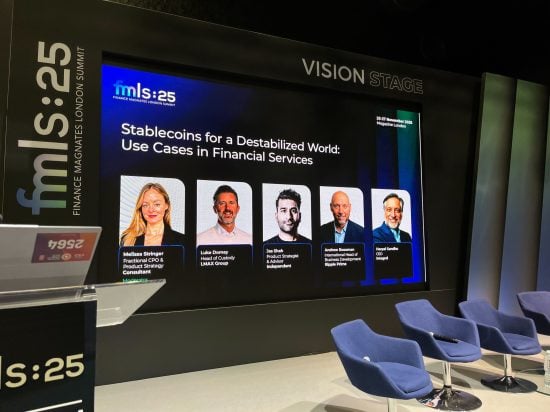
At this year’s Finance Magnates London Summit, the panel “Stablecoins for a Destabilized World: Use Cases in Financial Services” offered a clear view of how institutional finance may function over the next decade.
Moderated by Melissa Stringer, the discussion featured Luke Dorney (LMAX Group), Jas Shah (industry consultant), Andrew Rosoman (Ripple Prime) and Integral CEO Harpal Sandhu – whose perspective grounded the conversation in hard market structure and real-world credit constraints.
Harpal’s core message was deceptively simple: when the time and cost of moving money fall to zero, everything upstream in the value chain gets reinvented. Harpal considered tokenization capabilities and use cases to be analogous to what Voice over IP did to telecoms when voice was turned into packets and suddenly any cheap handset could route calls over the internet.
“Once money is programmable, instantly transferable, and effectively free to move, entrepreneurs will not replicate today’s systems on-chain; they will design entirely new ones.” – Harpal Sandhu, CEO Integral
Panel Takeaways
The Stablecoin ‘Stack‘
Luke Dorney outlined today’s stablecoin ecosystem as three layers:
- Issuers such as Tether, Circle, and Ripple’s ecosystem
- Blockchains including Ethereum, TRON, and Solana
- Connectors: wallet custodians, PSPs, exchanges, settlement intermediaries
It’s the third layer, he said, where institutional risk intensifies.
The ideology may be “instant on-chain settlement,” but the reality involves fragmented infrastructure, inconsistent controls, and incomplete wiring between treasury, risk and trading. Most institutions remain in tightly ring-fenced pilot mode, rather than full-scale deployment.
The Killer App Concept
Where others spoke about layers, Harpal spoke about bottlenecks and ways to remove friction. He noted that institutional FX has effectively been “tokenized off-chain” for decades, through credit lines, margin calls, and settlement obligations tracked in proprietary systems, with human and operational latency built in.
Stablecoins bring these dynamics fully on-chain with programmatic guarantees. To scale, Harpal argued, entrepreneurs need to create what Silicon Valley would call a killer app – solutions that remove friction so that tokenized finance becomes indispensable.
Harpal argued that crypto markets are a natural starting point, where credit, settlement and capital efficiency challenges are most acute. This is the foundation of PrimeOne, Integral’s new stablecoin-based institutional prime brokerage platform for crypto markets.
“By tokenizing U.S. dollars as iUSD, PrimeOne allows participants to open leveraged positions continuously marked to market, with P&L moving automatically between wallets in real time. Counterparty credit risk is minimized because the replacement-cost problem is handled continuously, not at end-of-day.”
– Harpal Sandhu, CEO Integral
Settlement at the Speed of the Internet
Andrew Rosoman compared today’s transition to the arrival of CLS in FX – only faster, cheaper and available 24/7. Stablecoins are emerging as a near-cash margin asset, enabling real-time collateral movement, continuous funding across time zones, and shorter settlement windows that previously locked up capital over weekends or holidays.
The Work: Shared Infrastructure, Not Legacy Tech
Jas Shah emphasized that the real challenges are not inside individual institutions but in the shared systems they rely on – investment books of record, vendor platforms, and cross-institutional infrastructure. He added that after 2008, the CDS market evolved through forced standardization, an arc he expects to repeat as stablecoin volumes rise. As flows scale, these systems will need to be rebuilt for near-real-time settlement, standardized data, and automated controls.
Real ROI
When Melissa pressed the panel on real ROI and “where the money is,” Jas tied back to Harpal’s “killer app” framing but extended it into B2B payments and global marketplaces.
For platforms like Shopify or Etsy, stablecoins can compress payout cycles, and support multi-region treasury models – unlocking global working-capital efficiency. This is where he believed the largest volumes, and the regulatory focus, will eventually concentrate.
Perhaps the most provocative moment came when conversation turned to retail flows and KYC. Melissa asked how institutions should handle investors who hold assets in non-custodial wallets and fall outside traditional pre-KYC frameworks.
Harpal’s response reframed the question. Assuming the customer is already yours, he said:
“…if money can move instantly and at zero cost, why wouldn’t that customer keep assets self‑custodied and then “plug in” to 100 different brokers at will?”
They could see balances across venues, route to the best price, execute, and pull funds back to their own wallet, with the broker functioning more like a credit and execution front‑end than a traditional asset custodian.
Harpal pointed to FTX as a cautionary case: a broker holding and rehypothecating client assets off-chain while presenting itself as an exchange. In a world of programmable, instant money, that structure becomes both unnecessary and unacceptable.
Underpinning this vision is signficant engineering. Harpal described how Integral has built a dedicated Layer-1 blockchain with sub-second block times, around 100x faster than Ethereum, and deploying escrowed, solidity-based stablecoins.
It is a ground-up design that’s used in PrimeOne for a virtually cost‑free credit system. Change the VM settlement cycle from T+1 or T+2 days to just T+1 minute and the economics of leverage, cost of capital, and access look completely different.
When Zero Changes Everything
The panel closed on a broader theme central to Harpal’s thesis: when zero enters a value chain – zero marginal cost of messaging, zero marginal cost of voice, and now near-zero cost and time to move money – incumbent models don’t transform. They evaporate.
“Just as VOIP wiped out telecoms’ cross-border rents, programmable stablecoin rails will make many fee-heavy, intermediated financial processes look as outdated as per-minute phone charges,” Harpal said. For tech-native users moving seamlessly between FX brokers, crypto apps, and payment platforms, this isn’t a future – it’s the baseline expectation.
Additional themes from the discussion included how brokers can differentiate in an AI-driven market.
The panel reflected on what differentiates brokers who successfully attract AI-driven and highly technical traders. Their insights emphasized the importance of adaptable infrastructure, strong partner ecosystems, and thoughtful investment decisions that help firms stay competitive and avoid becoming acquisition targets in a rapidly changing market.
Closing Thoughts
If there was a single takeaway, it was this: stablecoins are becoming the foundation of a new institutional credit and settlement layer.
Luke outlined the architecture. Jas mapped the operational realities. Rosoman demonstrated live flows. And in closing, Harpal pushed the room to consider what happens when zero finally arrives in the programmability of money – and why the winners will be the institutions that treat stablecoins not as a product line, but as the basis of an entirely new market structure.